


Rapidly growing businesses often lack the strategic marketing direction required to scale up.
If you can’t afford a marketing leader like a full-time Chief Marketing Officer (CMO) or VP of marketing, hiring a Fractional CMO might be the best choice.
Companies with great products can grow organically up to a point, but to really compete and scale up, you need to invest in your business’s marketing strategy. Having someone own the process, implementation, and success of marketing is essential.
A Fractional CMO can offer both the strategic direction and own the implementation of marketing initiatives.
Pro Tip: CMOs often come from a brand or performance perspective. Depending on your needs, be sure to discuss whether the Fractional CMO is someone who specializes on brand and will help you with positioning, messaging, design etc. or a performance-focused who will help build campaigns, get more leads, and improve conversions.
What is a Fractional CMO?
A Fractional CMO is a marketing executive who works with businesses on a part-time or contract basis to provide strategic leadership, usually for a fraction of the cost of a full-time hire.
A Fractional Chief Marketing Officer (CMO) takes ownership of the marketing decisions, strategy, and implementation on a part-time basis, and may be working with 2-3 companies at a time offering a high-level, strategic direction.
Who Needs a Fractional CMO?
Many small businesses like SaaS, SMEs, and Startups can benefit from a Fractional CMO service. Here are some of the usual reasons you might want to consider hiring one:
- You can’t afford a full-time CMO
- You have a small, inexperienced marketing team
- You need to develop a marketing, brand, and messaging strategy
- You need help to hire marketing talent or outsource
C-suite hires are expensive. Most CMOs in the U.S. start at $200k per year and average north of $300k according to Salary.com and Glassdoor. Not to mention benefits, insurance, and stock options.
On the other hand, founders and company owners might be great engineers, salespersons, and leaders, but do not always double as marketing experts.
If you don’t have an experienced marketer on the team to take the mantle of marketing leadership, then a Fractional CMO might be a great fit and help you scale the business.
For SaaS Startups: A Fractional CMO for a Startup might help manage a small team of juniors (2-3 people) and help a company with messaging, campaigns, and marketing strategy/leadership until they have PMF and enough budget to hire a full-time marketing leader.
For Small Businesses: A small business with low revenue (depending on location may be under $1 million or under $3 million) may require some marketing leadership temporarily to help scale up marketing operations and improve marketing metrics before they can afford a full-time marketing leader.
What Does a Fractional CMO Do?
The role and responsibilities of Fractional CMOs vary depending on the company needs. Their main responsibility is the ownership and success of the marketing efforts.
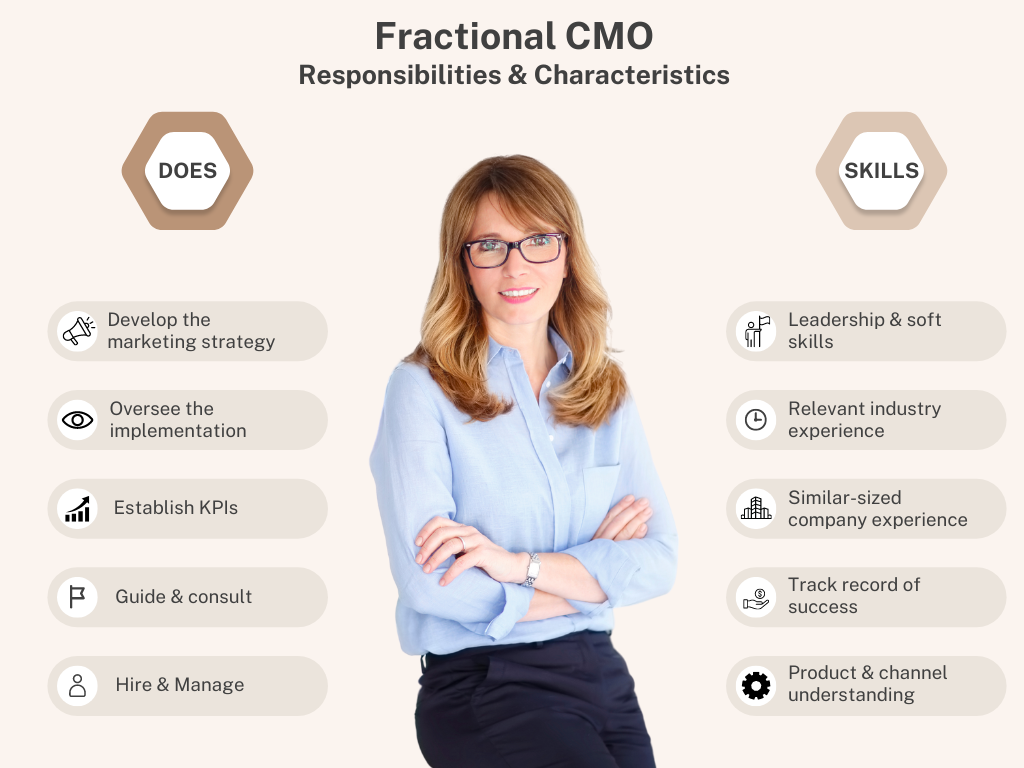
A Fractional CMO will have some or all of these responsibilities:
- Develop the marketing strategy
- Oversee the implementation and execution of the strategy
- Establish Key Performance Indicators (KPIs)
- Prepare or oversee marketing reports and metrics
- Guide & consult the marketing department
- Hire and manage the right people and/or agencies
Bringing in an experienced marketing professional can help develop a go-to-market strategy while giving directions to create your messaging, brand, and digital marketing strategy.
This is different from what a marketing consultant or an agency will deliver with a short-term marketing plan. A marketing executive will not focus on marketing campaigns and initiatives. They will act as your marketing leader and guide the marketing team.
The Benefits of a Fractional CMO
A part-time CMO will cost less and bring the same level of expertise to the table. Here are the benefits you will be looking for from a good Fractional CMO:
- Marketing expertise
- Cost savings (affordable)
- Flexible & scalable
- Access to top-tier talent
Companies are more flexible and can either scale or decrease the hours their Fractional CMO offers, depending on the needs.
And, we should never forget that c-level executives come with a vast network of collaborators, talent, and agencies. You are not just hiring for experience, but their network as well.
The Disadvantages of a Fractional CMO
Be careful when hiring an external person to lead your marketing team. Be careful not to fall into any of these pitfalls:
- Less focused on your business
- Equity hire might be a better choice
- Alienating the marketing team
Eventually, you want an executive who really gets your business and industry. A Fractional CMO is a good temporary option until you scale enough, but will not be as invested in your success as a full-time one.
Consider an equity-hire if you are a startup or growing company, offering stock instead of a high salary can be better at the early stages of a company and attract a CMO that will grind to scale the business.
It is a very important thing to consider as well as your marketing team. While hiring externally for the expertise you don’t have in-house, internal promotions are often better options. Enabling an employee to assume greater responsibilities can boost morale and employee retention, while you get someone who already knows your business and industry better than anyone else.

The Difference Between a Full-Time CMO vs a Fractional CMO
There are quite a few differences between how an in-house CMO will work and how Fractional CMOs work, here are the most important ones:
Cost: It costs less. A Fractional CMO working for 20 hours per month at $200 per hour will cost you less than $50k per year over a minimum of $200k for a full-time one.
Equity: When calculating the cost of a CMO or VP of Marketing, you might also calculate how much equity they will be asking. A Fractional CMO does not come with the same commitments and will not ask for equity.
Commitment & time spent: A Fractional CMO, by definition, will spend a fraction of their time on your business. While a full-time CMO will have the benefit of better understanding your business and committing to the success of the business.
Time on hiring: Hiring a CMO is a huge decision, and can take many months to find the right person. While you should scrutinize a Fractional CMO with similar criteria, this process is often faster and you can “test hire” a Fractional CMO (if they agree to as well).
How much does a fractional CMO cost?
So, how much does a Fractional CMO cost?
The pay varies a lot by location, expertise, industry, and business needs. You can expect an hourly rate of $200-$300, but you can find a cheaper or much more expensive CMO for hire as well.
Where to Find a Fractional CMO?
Similar to other executive-level positions, the best way to find the right candidate is by getting introduced to one. Employee referrals usually deliver better results, and this is especially true for higher-level positions.
How to do it?
- Ask your network (colleagues, business partners, investors, etc.)
- Work with a specialized agency
- Search through LinkedIn and look for industry experience
- Reach out to past marketing executives of competitors or other companies in the industry
- Post job adverts (not my recommended way)
Executive hires tend to network with CVs or Angel investors and keep a close collaboration with agencies specializing in helping companies find c-suite executives. Now, there are agencies specialized in Fractional hires.
How to Choose the Right Fractional CMO
As with any other marketing hire, you can’t choose anyone for the position. It’s important to find the right candidate with relevant industry experience.
What you are looking for in a Fractional CMO is years of experience and strategic direction, which means someone who understands the industry and struggles of a company your size.
Ideally, you want someone who comes with a “playbook” to get your company from its current size to the next, or can build one.
When reviewing candidates, be sure to look for:
- Leadership experience and soft skills
- Relevant industry experience
- Worked in a similar or slightly bigger company
- A proven track record of success
- Good understanding of your product & marketing channels
As each company’s needs vary, you will need to hire someone with the right skills and experience. But, above all, you need a good strategist and team leader.
Lastly, don’t forget to do your due diligence. This is why getting a good referral from your network matters. Reach out to people who have worked with this CMO before, review any claims, and set the goals and expectations early in the partnership.
Will Hiring a Fractional CMO Help Your Business?
A CMO can offer much-needed leadership and a strategic marketing direction, build your brand and handle difficult decisions. If you can’t hire a full-time in-house person, a fractional hire may make sense.
Whether this is a short-term position to help you grow, or manage a less experienced team, freelancers, or marketing agencies, a Fractional CMO service might be the right choice for your company.
Still, you will need to have marketing staff to handle the day-to-day work or outsourced resources such as a marketing agency or freelancers in place. One person alone will not make the difference you need to scale up.
But, before you hire a Fractional CMO, consider your business needs, budget, and whether you have the right marketing talent already in your team.
Outsourcing the marketing direction of your company can have both positive and negative impacts, and you should carefully consider both pros and cons.
Frequently Asked Questions (FAQs)
What is a Fractional CMO?
A Fractional CMO is an experienced marketing executive who works with a company on a part-time basis, providing high-level strategy and leadership without the cost of a full-time executive. They often serve multiple clients simultaneously. The job of a Fractional Chief Marketing Officer (CMO) is to take ownership of the marketing decisions, strategy, and implementation on a part-time basis.
What does a Fractional CMO do?
A Fractional CMO handles marketing strategy, budget management, team leadership, and vendor management. Unlike an agency that focuses on execution, a Fractional CMO focuses on the why and how of your growth strategy.
How much does a Fractional CMO cost?
Typical rates range from $200 to $300 per hour, or a monthly retainer of $3,000 to $10,000, depending on the scope of work and hours required. The cost may vary based on location, experience, and your company needs. Hiring remotely may give you access to cheaper talent as well.
What are the benefits of hiring a Fractional CMO?
A Fractional CMO comes with some advantages for companies on a tighter budget compared to hiring a full-time person.
- Marketing expertise
- Cost savings (affordable)
- Flexible & scalable
- Access to top-tier talent
What should I look for in a fractional CMO?
When reviewing candidates, be sure to look for:
- Relevant industry experience
- Worked in a similar or slightly bigger industry
- A proven track record of success
- Good understanding of your product & marketing channels
What is the difference between a Fractional CMO and a Marketing Agency?
A Fractional CMO acts as a leader who integrates into your team to set strategy, whereas a marketing agency is an external vendor hired to execute specific tasks like SEO, PPC, or content creation.
How does a Fractional CMO work?
They typically work on a retainer basis for a set number of hours per week (e.g., 5-10 hours). They attend leadership meetings, manage the marketing team, and are accountable for marketing KPIs just like an in-house employee.
Fractional CMO vs. Marketing Agency vs. Consultant: Which One Do You Need?
Many founders mistakenly use these terms interchangeably, but they serve very different functions in a growing business. Making the wrong choice here can lead to burnt budget and frustration.
Here is the breakdown of how a Fractional CMO compares to an agency or a consultant, and how to decide which one is right for your current stage.
Fractional CMO (The Strategic Leader)
A Fractional CMO is not an outsider looking in; they are a part-time member of your executive team. Their primary product is leadership and accountability.
They take ownership of the results, sit in leadership meetings, manage the marketing budget, hire and fire vendors, and build the internal processes your company needs to scale.
- Best for: Companies that have product-market fit but lack a cohesive strategy to grow.
- Key Focus: Strategy, Team Building, Revenue Accountability.
Marketing Agency (The Execution Engine)
An agency is an external vendor hired to execute specific tasks. You hire them because you need people to do the work you’ve already decided needs to be done.
Agencies are excellent at scaling execution—whether that’s writing 10 blog posts a month, managing ads, or designing a new website. However, an agency requires someone internal to manage them. Without a CMO (Fractional or Full-time) guiding them, agencies often lack the strategic context to drive business-level results.
At a minimum, a marketing agency will require an internal project manager, either a marketing manager or the founder/CEO should be involved and have time to implement or delegate some work and hours to coordinate with the agency.
- Best for: Companies that already have a strategy but need manpower to execute it (e.g., SEO, PPC, Content).
- Key Focus: Deliverables, Specialized Skills, Execution.
Marketing Consultant (The Problem Solver)
A consultant is typically hired for a defined project with a clear start and end date. They are advisors, not doers.
You might hire a consultant to audit your current setup, solve a specific crisis, or train your team on a new methodology. Once they hand over their report or recommendations, their job is usually done. They rarely stick around to ensure the implementation is successful.
- Best for: Solving a specific, isolated problem or getting a second opinion.
- Key Focus: Audits, Advice, Short-term Projects.
Hiring a consultant requires to have the internal capacity or a number of other vendors (freelancers, agencies) to execute on the advising. Consultants different from fractional as they won’t be taking ownership of the results.
Comparison: Who Owns the Outcome?
The biggest difference lies in “Ownership.”
| Fractional CMO | Marketing Agency | Marketing Consultant | |
| Primary Role | Leadership & Strategy | Execution & Production | Advice & Audits |
| Relationship | Part of the Team | External Vendor | External Advisor |
| Accountability | Owns the KPI / Revenue Target | Owns the Deliverable (e.g., Leads/Traffic) | Owns the Recommendation |
| Duration | Long-term (6-12+ months) | Ongoing Retainer | Project-based (Short-term) |
| Cost Structure | Monthly Retainer ($3k – $10k+) | Retainer or Performance Fee | Hourly or Project Fee |
So, Which One Should You Hire?
- Hire a Fractional CMO if: You have a marketing budget and a team (or freelancers), but you feel like the ship has no captain. You need someone to tie everything together into a strategy that drives revenue.
- Hire an Agency if: You know exactly what you need (e.g., “We need more organic traffic”) and you have someone internal who can manage the agency to ensure they deliver.
- Hire a Consultant if: You are stuck on a specific problem (e.g., “Our churn rate is too high” or “We need a brand refresh”) and need an expert to diagnose the issue before you fix it.

Nick Malekos is the Head of Growth & Demand Generation at Cyberbit, with a background in SEO, Content Marketing, and Performance. He is specializing in helping SaaS startups and scale-ups grow.


